

The Form Nobody Talks About: Inside the Accelerated Skilled Worker Procedure
What actually has to happen before a nursing candidate's visa file moves — and why "accelerated" doesn't always mean fast.

Every few weeks, a candidate asks me: "My employer already signed my contract. Why is my visa still not moving?"
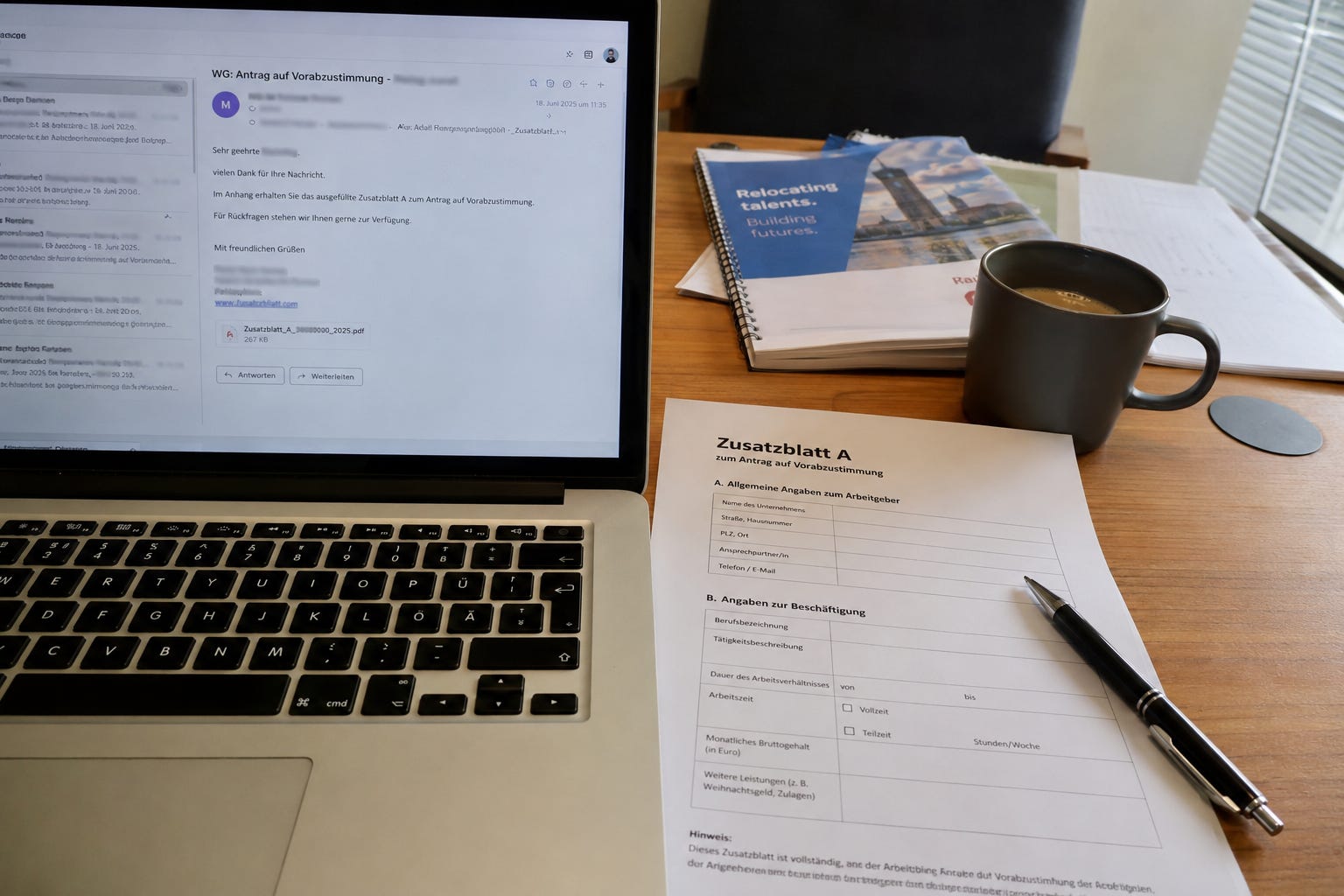
The honest answer is usually a stack of paperwork nobody outside German immigration law ever hears about — and one German-specific process called the beschleunigte Fachkräfteverfahren, or accelerated skilled worker procedure.
Here's how it actually works, using a real file I was pushing forward this week for two nursing candidates headed to a hospital group in Bavaria.
Step 1: Two declarations, not one.
Before a foreign nursing qualification can be formally recognized in Germany, the employer has to commit — in writing — to the terms of employment twice: once for the period before recognition (when the candidate typically works as a Pflegehilfskraft, a nursing assistant, on a lower pay grade) and once for after recognition, when the full nursing qualification and pay grade kick in. These are the "Erklärung zum Beschäftigungsverhältnis vor/nach Anerkennung" — employment declarations before and after recognition.
Step 2: Zusatzblatt A.
This is a supplementary form the state immigration authority needs alongside the declarations. It sounds minor. It is not optional. Miss it, and the whole file sits in limbo.
Step 3: The state authority, then the federal labor agency.
All of this goes to the ZSFE — the state's central office for skilled worker immigration (each German state has its own) — which reviews the file and forwards it to the Bundesagentur für Arbeit, the federal employment agency, for approval of the candidate's role.
Step 4: The part nobody mentions — payment.
Here's what surprises most people: none of this moves until the employer pays the fee for the accelerated procedure. Not the candidate. The employer. This week, that was the actual bottleneck — a two-month-old file waiting on an internal payment approval, not on any candidate document.
So this week's "recruiting" work looked like this: forwarding two candidates' documents to the state authority, then following up — twice — on a payment that had already been promised, so the accelerated procedure could actually start living up to its name.
Why this matters if you're a candidate:
If your visa file feels stuck, it's worth asking your recruiter or employer specifically which of these steps it's sitting at. "Waiting on documents" and "waiting on payment" are very different problems with very different fixes.
Why this matters if you're an employer:
The accelerated procedure genuinely does move faster than the standard route — but only once every declaration, form, and fee is in. Employers who treat the fee as an afterthought lose the exact speed advantage they paid for.
None of this is glamorous. It's forms, follow-ups, and one form nobody's heard of until it holds up their case. But it's also exactly the kind of detail that determines whether a nursing candidate starts their job in three months or six.
Step by step. Real process. Real people.