

Story of Sahanuj - Nurse from India Who Made it to Germany
The complete timeline of events, processes, challenges, hard work, and determination to reach Germany from India

Before I tell you Sahanujjaman’s story, let me give you a number: only 44 jobseekers exist in Germany for every 100 open qualified nursing positions. Not 80. Not 60. Forty-four. Germany’s Federal Employment Agency confirmed this in their latest nursing labour market report, and the gap is widening every year. Since 2022, every single net increase in Germany’s nursing workforce has come exclusively from foreign workers, the domestic supply is not just stagnant, it is shrinking. In geriatric care, the number of German-passport nurses actually fell by 4% in 2023/2024.
Germany needs people like Sahanuj. And Sahanuj needs Germany. What I want to show you in this article is exactly what that journey looks like. Not in theory, but in real dates, real obstacles, real costs, and real hours of sacrifice.
The beginning - 14th July 2025
On the 14th of July 2025 the journey began. My colleague and I did the internal interview of Sahanujjaman to check his German skills, nursing skills, motivation to come to Germany, and whether he could be a match for the employer. The interview went well and both of us were satisfied with the candidate. At that point in time, Sahanujjaman had written his German B2 exam just one week before the interview — which means he still did not have his B2 certificate in hand.
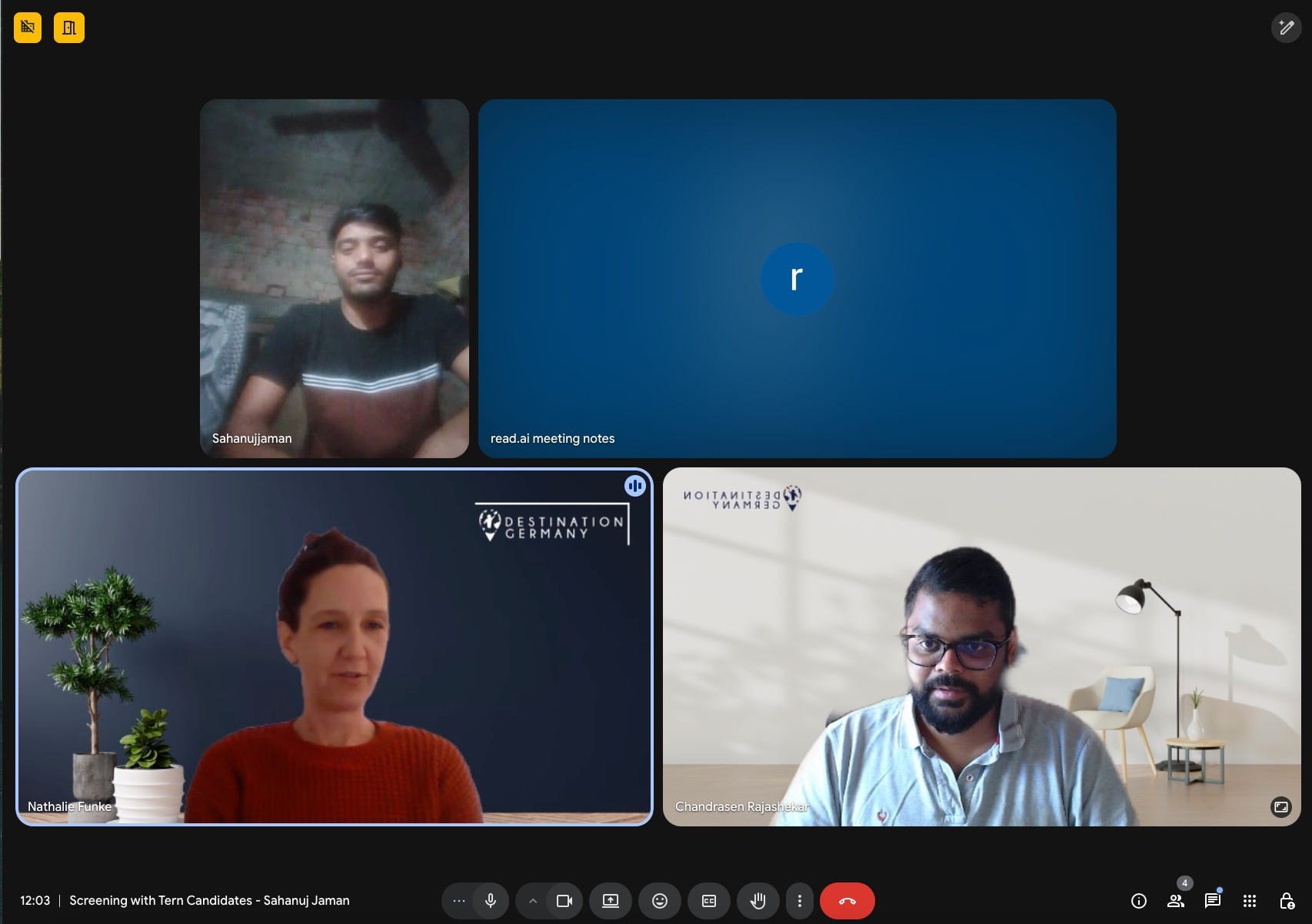
We submitted the candidate to our employer, a residential care home in Baden-Württemberg on the 18th of July 2025, and he received his Microsoft Teams interview invitation on the 21st of July 2025. The interview was with HR and the Nursing Management who would become his future bosses. It lasted about 45 minutes. During the interview, the interviewers assessed his German speaking and listening skills, his nursing knowledge, his motivation to come to Germany and work for them, his knowledge about the work location, and whether he was comfortable working and living in a smaller German city. Sahanujjaman cracked the interview and the employer told me they wanted to hire him.
The job offer and the document marathon - August to October 2025
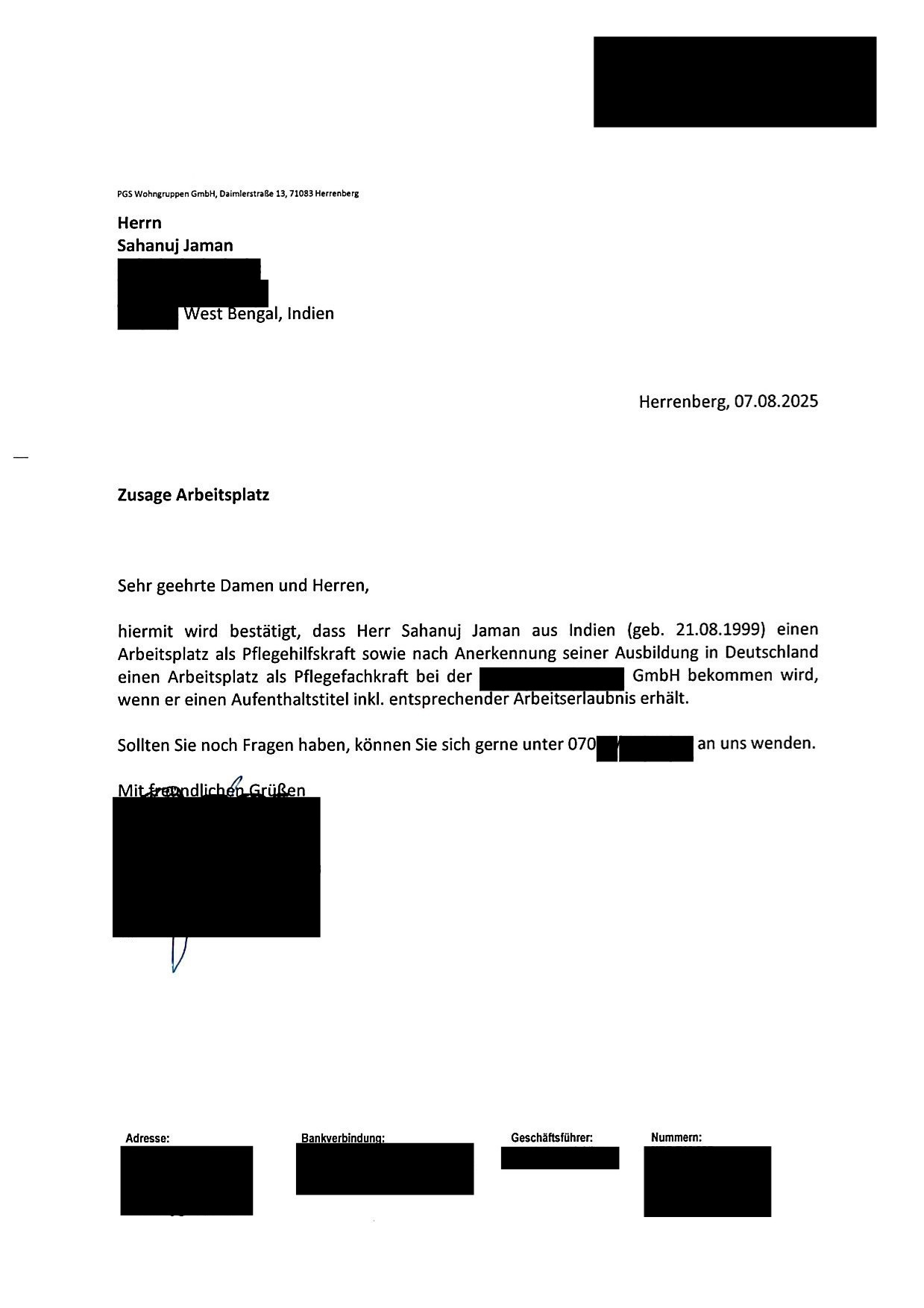
He received the job offer from the employer on the 7th of August 2025. From this point onwards I started preparing all the documents required to initiate the application for the Defizitbescheid, the official recognition deficit notice that determines what additional training a foreign nurse needs before they can practise in Germany.
By 13.10.2025 I had prepared all the documents required to apply for the Antrag auf Anerkennung Ihres ausländischen Bildungsabschlusses als Pflegefachmann and I received the confirmation letter from RP Stuttgart on the same date saying all documents had been received. If you want to know exactly which documents are required, you can find the full list here: RP Baden-Württemberg — Pflegeberufe.
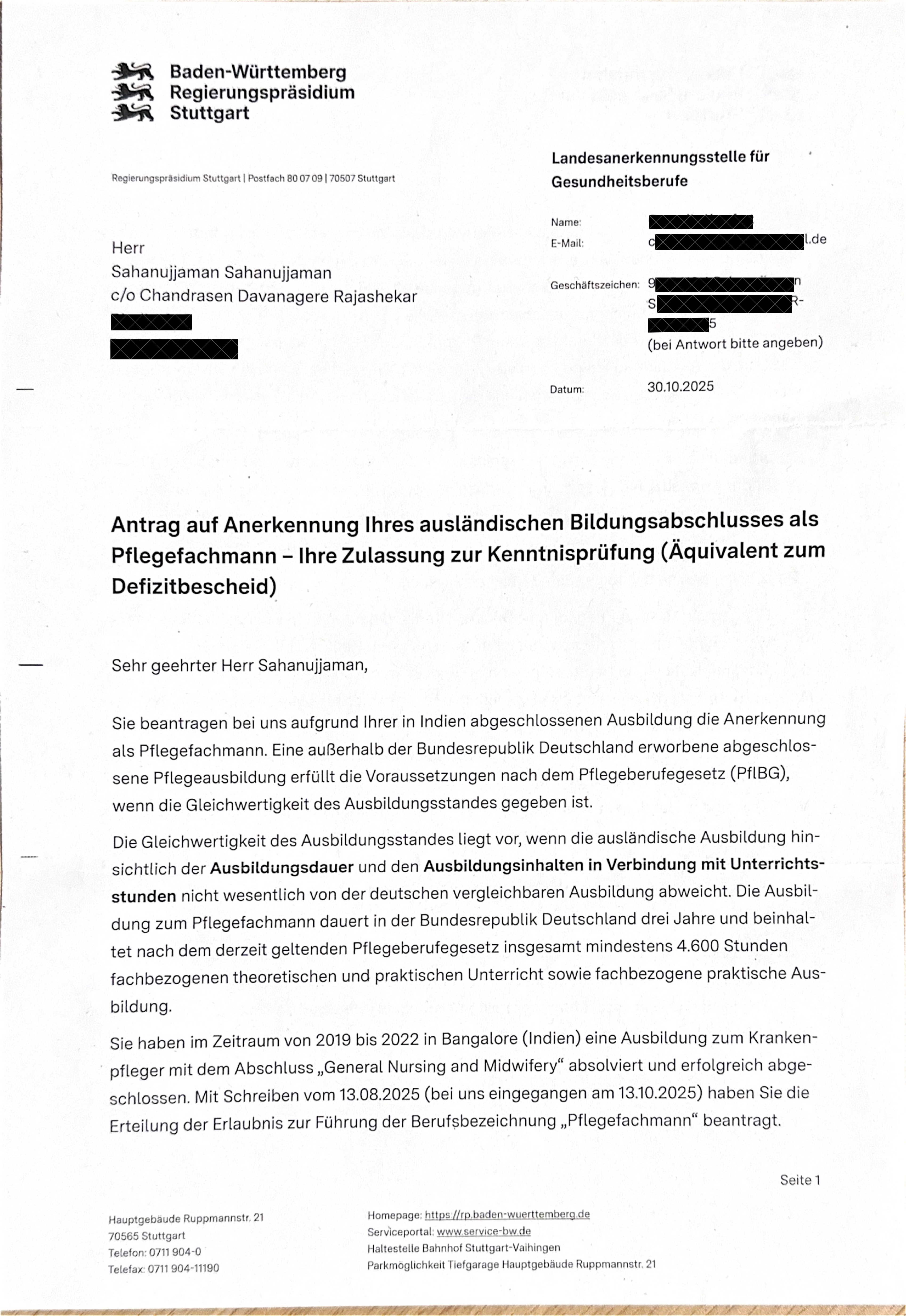
Then something worth highlighting happened. On 30.10.2025, just 17 days after submission, I already received the Äquivalent zum Defizitbescheid for Sahanujjaman.
Before the second half of 2025, it was taking more than four months to receive the Defizitbescheid from RP Stuttgart. That was one of the most painful bottlenecks in the entire process for everyone involved employers, candidates, and agencies alike. At some point in 2025, RP Stuttgart shifted their approach and began issuing an Äquivalent zum Defizitbescheid, a document which can be used to apply for the visa or proceed with the fast track procedure, just like the actual Defizitbescheid. 17 days vs. 4+ months. That is the difference, and it matters enormously for everyone waiting.
The B2 problem - three attempts, one winner
Now that the Defizitbescheid was in place, the only missing piece to start the fast track procedure was Sahanujjaman’s B2 certificate. Unfortunately, he had to attempt the B2 exam three times before passing.
He wrote his third attempt on the 17.12.2025 and received his results on 09.01.2026, he passed the TELC B2 exam with 80%.
Three attempts. I want you to sit with that for a moment. Each TELC B2 exam attempt in India costs roughly ₹30,000. Three attempts alone is ₹90,000 nearly five months of salary for a fresh GNM nurse in India, where entry-level earnings typically sit between ₹15,000 and ₹25,000 per month. And this is just one line item in a much larger investment, which I will come back to in the numbers section below.
The fast track procedure - January to February 2026
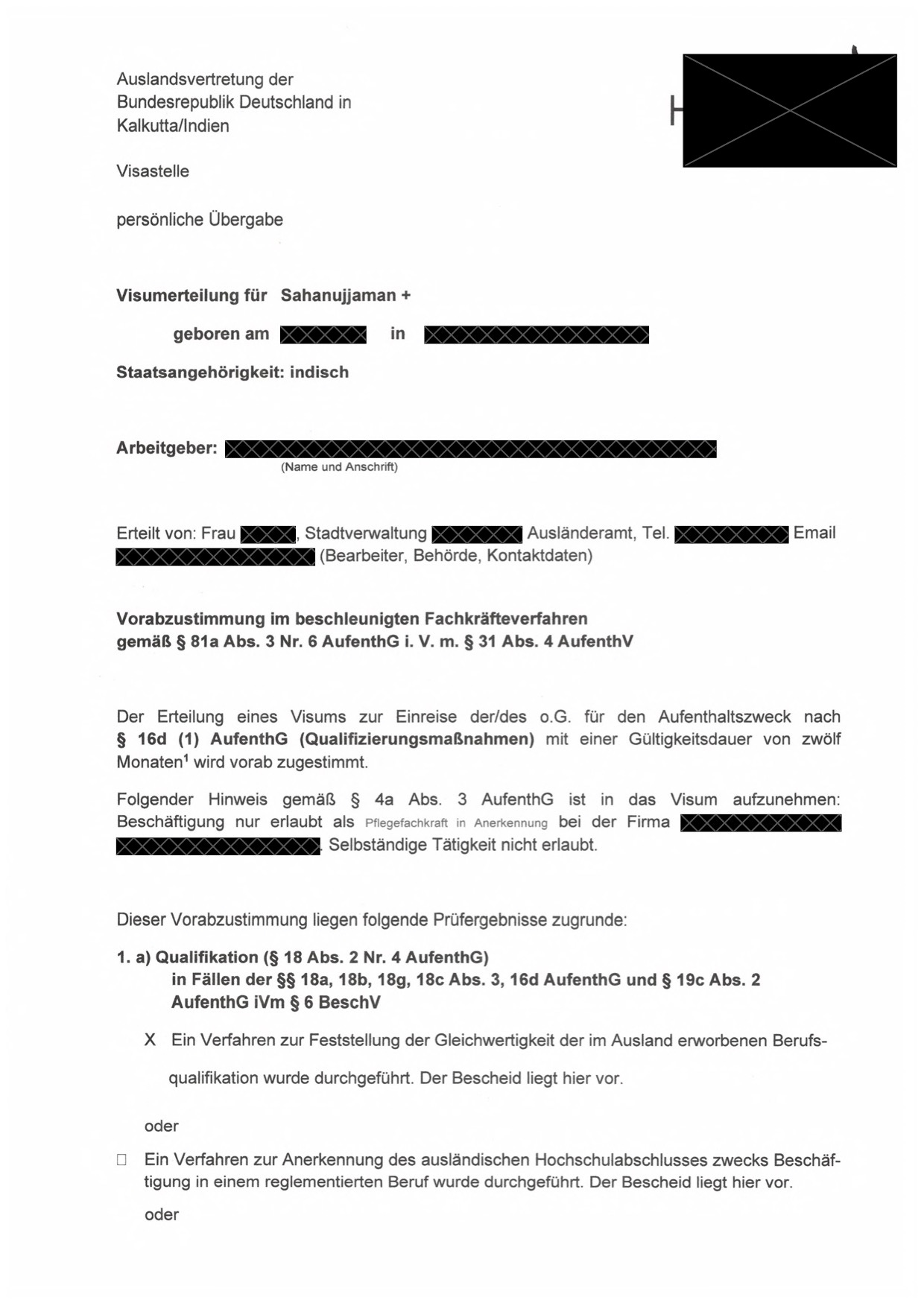
On 23.01.2026 I wrote an email to the Ausländerbehörde responsible for the area where the employer is based. After submitting the Erklärung zum Beschäftigungsverhältnis, the Weiterbildungsplan, and Zusatzblatt A for Sahanujjaman, I received the Vereinbarung via post, which I signed and returned. On the 13th of February 2026, I received the Vorabzustimmung the pre-approval.
From submitting the fast track documents to receiving the pre-approval: 21 days. This is how the fast track procedure is supposed to work when the caseworker is responsive and the documents are complete and correct. It does not always go this smoothly, but when it does, it is impressive.
The visa appointments - March to April 2026
Sahanujjaman booked his visa appointment under the sub visa category Fast Track Procedure acc. to §81a AufenthG at the Kolkata German Consulate for 10.03.2026. He was fully prepared with all his documents.
But during the appointment, the person checking documents sent him back because the date on his Demand Draft was not printed exactly within the designated date box on the form.
Let that sink in. After months of preparation, 604 days of effort, three B2 exam attempts, and ₹4,00,000 invested, someone sent him home because of how a date was printed on a bank draft.
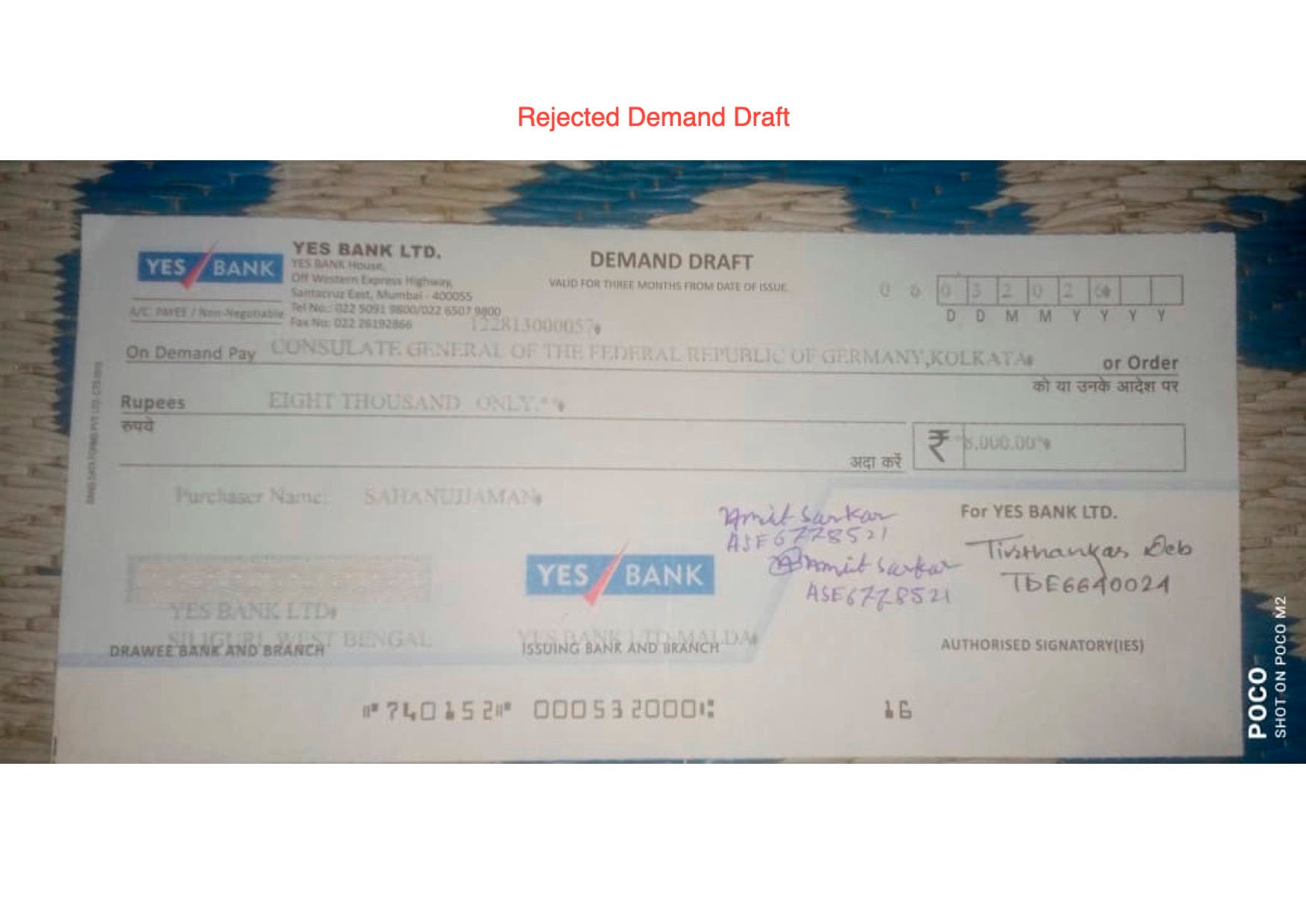
The candidate was very disappointed, but with courage he booked a second appointment for 26.03.2026. This time the Demand Draft was perfectly legible, so that was not a problem. However, the visa interviewer was humiliating towards Sahanujjaman because of his English and made him feel extremely bad.
I want to be direct about this: a person who spent 3,376 hours learning German, a language that is not even used in their country of origin was humiliated at a German consulate for not speaking English well enough. The irony should not be lost on anyone.
Despite all of this, Sahanujjaman received his visa on the 17th of April. He got it after writing to the Kolkata Consulate himself asking for an update, and they responded asking him to come in that day to collect his passport.
Arrival - 27th April 2026
On 20.04.2026 the travel company booked his flight for 26.04.2026. I went to pick him up from the airport on the 27th of April and drove him to his new home — a small town in Baden-Württemberg.
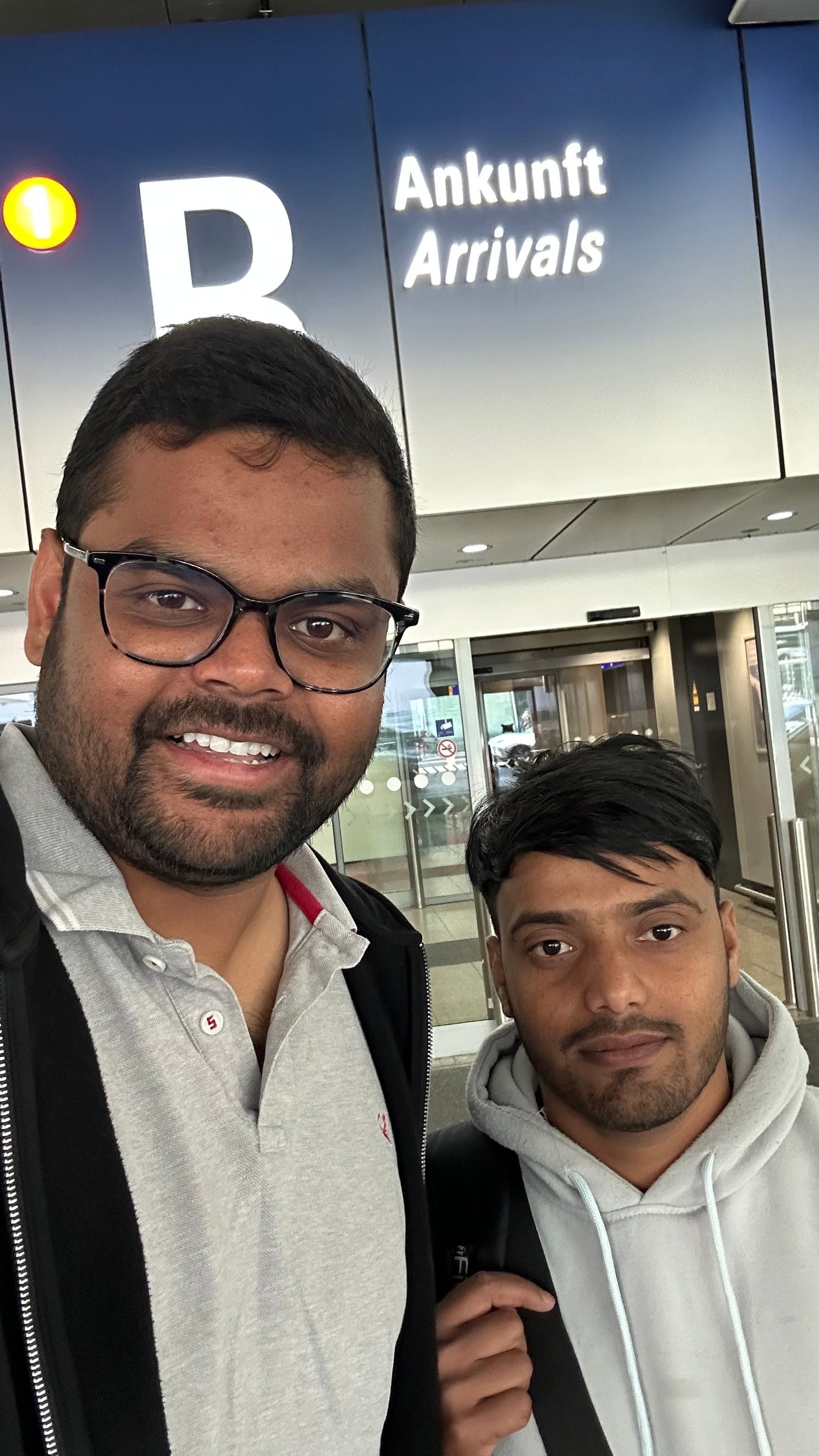
During the drive, Sahanujjaman shared his story with me. He comes from a lower-middle-class family with six siblings. He is the youngest. He did his GNM nursing from Bangalore, worked for one year as a nurse, and then started learning German for nine months. His father is a retired police officer. While learning German, he was also working part-time at a catering company in Delhi to cover his expenses. When preparing for the B2 exam specifically, he was studying German for eight hours every single day.
What the numbers actually say
The journey started on the 14th of July 2025. Sahanujjaman reached Germany on the 27th of April 2026. That is 9 months and 13 days - 287 days - from the first interview to arrival.
But the real journey started much earlier. Sahanujjaman began learning German in September 2024. From that first German lesson to the day he landed in Germany is 1 year, 7 months, and 26 days - 604 days in total.
In the 287-day agency process alone, 72 emails were exchanged between the employer, the candidate, RP Stuttgart, and the Ausländerbehörde.
Milestone Time Employer wait (interview → Sahanujjaman’s first day) 8 months / 32 weeks Sahanujjaman’s total journey (started German → arrived Germany) 1 year 7 months / 87 weeks My time managing the entire process ~128 hours
The cost Sahanujjaman paid
German language classes ₹1,75,000
Document translation ₹20,000
B2 exam - 3 attempts ₹90,000
Visa and miscellaneous ₹20,000 F
irst month costs ₹50,000
Total ₹4,00,000
70% of this total - ₹2,80,000 - was spent on the German language alone.
Now let me put that ₹4,00,000 in context. A fresh GNM nurse in India earns somewhere between ₹15,000 and ₹25,000 per month. Taking the midpoint of ₹20,000, ₹4,00,000 represents 20 months of salary - nearly two full years of income - invested upfront, before earning a single euro.
This is not a decision you take lightly. This is a bet on yourself.
The 3,376-hour question
If we conservatively say Sahanujjaman was actively learning German for 70% of his 604-day journey, that is 422 days. He told me he had 8 hours of German classes, 5 days a week, for the first 9 months and then continued at 8 hours per day every day until he cleared B2.
That comes to approximately 3,376 hours of German learning.
For comparison: researchers estimate it takes roughly 2,000 to 4,000 hours to reach professional-level competence in a new programming language or technical skill from scratch. Sahanujjaman did the language equivalent of becoming a software developer while working a part-time job, from a city in India, in a language spoken nowhere around him.
Why this story matters beyond one person
Germany currently has over 300,000 foreign nursing staff working within its borders, that is 17.8% of the entire nursing workforce. And according to Destatis, Germany will need at least 150,000 additional nurses by 2040 just to keep up with its ageing population. The demand will not slow down.
Every Sahanujjaman who makes it through this process is not just one person achieving their dream, they are one node in a system that Germany genuinely depends on to function.
But the process is hard. It is long. It is expensive. And at times as we saw at the consulate in Kolkata it is unnecessarily humiliating.
That is exactly why stories like this need to be told. Not to scare people away, but to show what is truly required and to show that it is possible.
Sahanujjaman started with almost no German. He came from a family where his father worked as a police officer and he had to take a part-time catering job just to afford his classes. He failed B2 twice. He was turned away at the consulate over a badly printed date. And he still made it.
If you are reading this and wondering whether you have what it takes the answer, based on what I have seen, is not about talent. It is about whether you can sustain effort across 604 days when the results are not yet visible.
Sahanujjaman could. And now he is in Germany.
If you found this article useful, I write about the real processes, numbers, and stories behind making it abroad — particularly in Germany. You can follow along on YouTube, LinkedIn, or this blog.